
A midterm reality check

28th October 2026
When America’s founders designed the House of Representatives, they gave its members just two-year terms, far shorter than the president’s or the Senate’s. The aim, as James Madison put it, was to give the House an “immediate dependence on” the people.1 As a result, voters can change the balance of power halfway through a presidency.
They get that chance at this year’s midterms on 3 November, when all 435 House seats and 35 of the 100 Senate seats are contested. Investors have been watching Washington closely. In September the 10-year Treasury yield, the rate the US government pays to borrow for a decade, rose above 5% for the first time since 2023.
In our previous insight piece, we argued that the gilt market judges daily whether the UK’s public finances add up, whoever occupies Downing Street. The US Treasury market does the same. Bond investors don’t wait for an election to form a view, but elections do decide who gets to make the decisions they are judging, and how easily those decisions can be made.
Why this midterm matters
Congress, which makes laws and controls federal spending, has two chambers. The House of Representatives has 435 members, with seats allocated by state population. The Senate has 100 members, two per state, who serve six-year terms, with around a third elected every two years. When one party holds the White House and both chambers, this is known as unified government.
President Trump currently benefits from unified government, although the House majority is narrow.
His power still has limits. The courts can block executive action, while Senate rules and divisions within his own party can slow legislation.
Even so, unified government has made major legislation easier to pass, particularly on tax and spending, as last year’s One Big Beautiful Bill Act showed. The administration has also used executive orders extensively in areas such as trade and regulation (shown in the chart below).
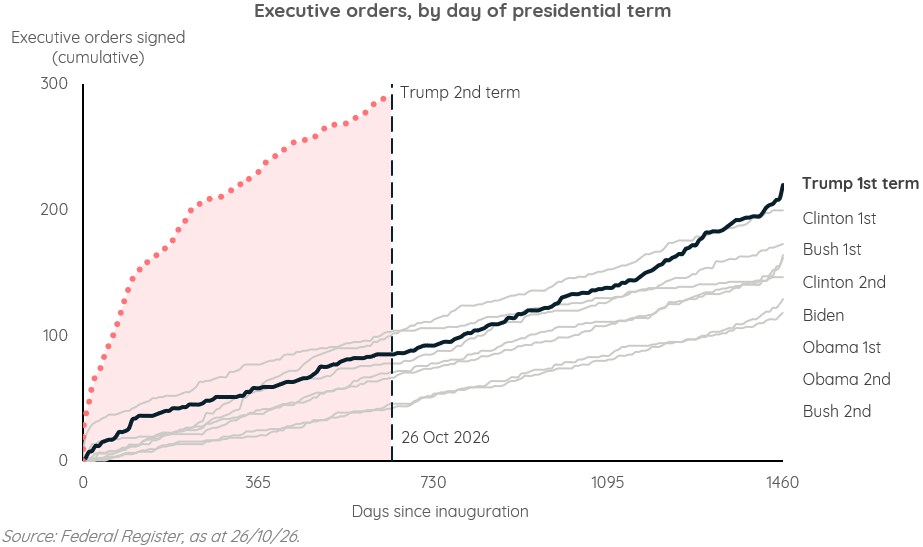
Midterms have long given voters a chance to take stock of the sitting president, but they rarely reward the governing party. Since the 1930s it has gained House seats only three times, most recently in 1998 and 2002, when the president’s approval rating was above 60%. In August, President Trump urged supporters to “pretend, please, that I’m on the ballot”,2 but with an approval rating of around 36% (as of 26 October 2026), largely because of the cost of living, that framing could help motivate his opponents just as much.3
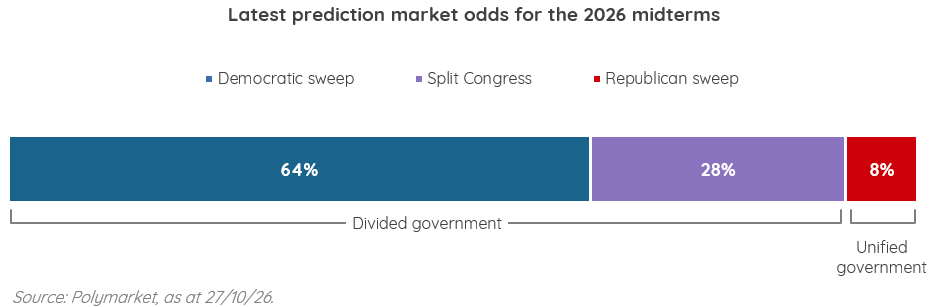
At the time of writing, prediction markets suggest the pattern of punishing the incumbent is set to hold.4 A Republican loss in either chamber would end unified government, making it harder for the administration to pass major tax and spending legislation. As the chart below shows, betting markets see a divided government as the most probable outcome.
A Democratic House looks likely, though perhaps by a narrow margin. Redistricting, and voters’ tendency to cluster in like-minded areas, have cut the number of competitive House seats from around 100 in 2010 to 43 as of early October.5 With fewer seats in play, swings are smaller, and in a slim majority a handful of rebels can block legislation.
The Senate race is closer. Republicans hold 53 seats, so Democrats need a net gain of four seats, some of which would have to come from states President Trump won by more than ten points in 2024.
What divided government means in practice
The most immediate effect would be on the policy agenda. Most new laws need the approval of both chambers and the President, so divided government would force more compromise and narrow the range of tax and spending measures that could pass. Overriding a presidential veto takes a two-thirds majority in both chambers, so an opposition Congress can block legislation far more easily than it can pass its own.
Control of the House also decides who chairs its committees and much of what Congress chooses to investigate. A Democratic majority could hold hearings and issue subpoenas.
The House can impeach a president with a simple majority, but removal requires a two-thirds vote in the Senate. Even if Democrats won both chambers, removal would require substantial Republican support. The Senate also confirms senior executive officials and federal judges, so control of it matters in its own right.
Trade policy shows how these constraints work in practice. In February, the Supreme Court blocked one route the administration had used to impose tariffs, and the White House turned to other trade authorities, some of which restrict how high tariffs can go and how long they can stay in place. The result was that tariffs remained, but with far less flexibility than before.
Policy could therefore keep moving after November, particularly through executive action, but anything requiring legislation might face a slower and more contested route.
What it means for markets
Equities
For equities, a divided Congress cuts both ways. Last year’s package made the 2017 tax cuts permanent and restored generous tax breaks for business investment, boosting post-tax profits for many companies. Extending or adding to measures like these requires Congress, and a divided one would make that far harder.
Slower policymaking could also bring more predictability after a period of frequent changes to tariffs, taxes and regulation. However, presidents who lose control of Congress often lean harder on executive action to keep their agenda moving, and this administration already relies on it heavily.
The effects would vary across the market. A company that relies on imported components may benefit if further tariff increases become harder to pursue, while a domestic producer protected by those tariffs may not. As we noted in The US election effect, sector calls made around elections have often gone the wrong way. Take fossil fuel companies which prospered under President Biden, or clean energy which did well during President Trump’s first term.
Any reaction may also be modest. Markets respond more to surprises than to outcomes expected for months, and a Democratic House and harder budget negotiations are already widely anticipated. A bigger move would be more likely after a much larger Democratic win than prediction markets suggest, or a Republican upset. More broadly, a change in Congress is rarely what drives equity markets. The House changed hands in November 2022, but that year was dominated by inflation and the Federal Reserve’s rapid interest rate rises, with the S&P 500 falling by around 18%.
Bonds
Bond investors may see the same gridlock differently. A divided Congress would make further tax cuts harder to pass. Equity investors would welcome those cuts, but they add to government borrowing, so blocking them could reassure the bond market. Gridlock does not guarantee restraint, though, as split Congresses often agree deals that raise spending on both sides’ priorities.
Nor would it change the existing debt path. The Congressional Budget Office expects debt held by the public to rise from around 101% of GDP this year to 120% by 2036, driven by Social Security, healthcare and rising interest costs. Neither party is proposing meaningful spending cuts or tax increases.
The bigger risk is brinkmanship. The $41.1 trillion debt limit is expected to be reached in 2027, and control of either chamber would give Democrats leverage. Past stand-offs contributed to downgrades by Standard & Poor’s in 2011 and Fitch in 2023, although Treasury yields fell after the 2011 downgrade. The clearer costs have been disruption in short-term Treasury bills and a gradual loss of confidence that can push up longer-term yields.
The Senate also confirms nominees to the Federal Reserve Board, so a Democratic majority could act as a check on threats to the Fed’s independence.
On balance, divided government would do little to change America’s debt path, but it would raise the risk of short-term disruption. As with equities, though, inflation and the Federal Reserve’s interest rate decisions are likely to matter more for Treasury yields than the result in November. As with gilts, the bond market’s verdict on America’s finances will not wait for the next election.
Our approach
America’s founders gave the House two-year terms so that it would respond quickly to the public mood, and this year that mood is being shaped largely by the rising cost of living. A Democratic win in either chamber would end unified government and slow the pace of legislation. Policy would keep moving through executive action, however, and the pressures on America’s public finances would still be there on 4 November.
The weeks after the vote will bring plenty of noise, as potential new majorities set out their priorities and both parties turn to 2028. Little of it is likely to say much about where markets go next. Inflation, interest rates and company earnings have usually mattered more than politics, and we do not think the midterms offer a reliable basis for a market call. The House changes its mind on a fixed timetable, every two years. We know markets keep no such calendar, and neither do our portfolios.
If you have any questions on the above or to find out more about our investment service, please call 020 7287 2225 or email hello@edisonwm.com.
Important information
This insight piece does not constitute advice.
The value of investments and the income arising from them can go down as well as up and is not guaranteed, which means that you may not get back what you invested. Past performance is not necessarily a guide to the future.
Sources:
1 Federalist No. 52, 8 February 1788. Bill of Rights Institute, https://billofrightsinstitute.org/primary-sources/federalist-52/.
2 Bloomberg, “Trump’s New Midterm Pitch to Voters: Pretend I’m on Ballot”, 22/08/26.
3 The New York Times, “President Trump Approval Rating: Latest Polls” https://www.nytimes.com/interactive/polls/trump-approval-rating-polls.html.
4 Polymarket, “Balance of Power: 2026 Midterms”.
5 Cook Political Report, “2026 CPR House race ratings”.
Chart sources: Executive order chart: Federal Register, as at 26/10/26. Prediction markets chart: Polymarket, as at 27/10/26.
Edison Wealth Management Limited is authorised and regulated by the Financial Conduct Authority. The company is registered in England and Wales and its registered address is shown below. The company’s registration number is 06198377 and its VAT registration number is 909 8003 22. The Financial Conduct Authority does not regulate tax planning or trusts.
The information contained within this insight piece is based on our understanding of legislation, whether proposed or in force, and market practice at the time of writing. Levels, bases, and reliefs from taxation may be subject to change.
<< Back to Insights


Contact us to see how we can help.
+44 (0) 20 7287 2225
hello@edisonwm.com
The value of investments and the income arising from them can go down as well as up and is not guaranteed, which means that you may not get back what you invested. Past performance is not necessarily a guide to the future. The information contained in this website does not constitute advice. The FCA does not regulate tax advice. The FCA does not regulate advice on Wills and Powers of Attorney. The Financial Ombudsman Service is available to sort out individual complaints that clients and financial services businesses aren’t able to resolve themselves. To contact the Financial Ombudsman Service please visit www.financial-ombudsman.org.uk.